
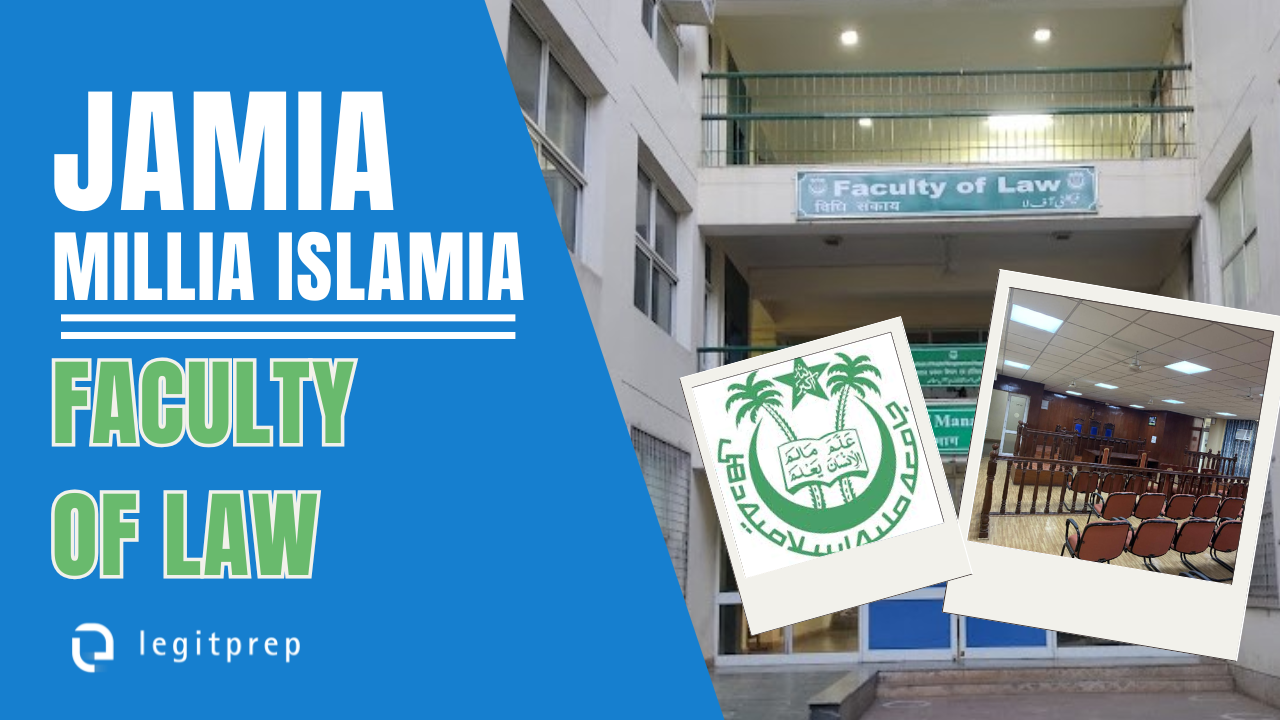
Institutional profile, academic framework, infrastructure, faculty & recommendations for prospective students.
INSTITUTIONAL FOUNDATION AND COMPETITIVE STANDING
1.1 Institutional Pedigree and History
The Faculty of Law, Jamia Millia Islamia (JMI), stands as a distinguished institution operating under the aegis of Jamia Millia Islamia, a comprehensive, research-intensive Central (Public) University. The Faculty was formally established in 1989, initiating its academic journey by offering the traditional three-year LL.B. programme.
The early 2000s marked a pivotal era of modernization and curriculum expansion. From the academic session 2000–2001, the Faculty introduced a two-year Post-graduate Programme (LL.M.) and a Ph.D. programme. In the academic session 2002–2003 the faculty introduced the five-year integrated B.A., LL.B. (Hons.) programme, replacing the older three-year LL.B. course. The first LLB/BA LLB batch under the faculty graduated in 1992.
1.2 National Recognition and Ranking Analysis
The Faculty benefits from its affiliation with JMI, which holds an A++ NAAC grade and was ranked 3rd among all universities in India by NIRF (2024). The Faculty of Law itself has consistently ranked among India’s top legal institutions.
National Rankings of Faculty of Law, JMI (Latest Available Data)
| Ranking Body | Year | Category | Rank Achieved |
|---|---|---|---|
| NIRF (Ministry of Education) | 2025 | Law | #8 |
| NIRF (Ministry of Education) | 2024 | Law | #6 |
| IIRF | 2025 | Law | #6 |
| India Today | 2024 | Law | #15 |
| India Today Magazine (Historical) | 2017 | Law | #1 (Among top 14 universities) |
Sustained placements within Top 10 rankings signal strong performance on graduation outcomes, teaching quality, and faculty-student ratio. Being part of a premier Central University provides additional institutional resources (e.g., Zakir Hussain Central Library, Residential Coaching Academy).
ACADEMIC FRAMEWORK AND COURSE ARCHITECTURE
2.1 Undergraduate Program Structure
The flagship programme is the B.A. LL.B. (Hons.), a five-year integrated, full-time course combining humanities and core legal principles.
Dual Mode Intake and Fee Structure
- Regular Mode: Highly subsidized fee structure (reported approximately ₹15,000 per annum).
Classes are typically in the morning (9:30 am to 1:45 pm). - Self-Financed Mode: Higher but competitive fee (reported approximately ₹55,000 per annum).
Classes are typically in the evening (2:00 pm to 6:00 pm).
Admission to both streams is determined by the JMI Entrance Exam and requires a minimum of 50% marks in the 10+2 examinations. The Regular mode offers exceptional financial advantage and broadens access.
INFRASTRUCTURE AND LEARNING RESOURCES
3.1 Faculty Infrastructure
Located on the Central Delhi campus, the Faculty benefits from a dedicated law wing with spacious, well-lit, ventilated and ICT-enabled classrooms. Additional learning spaces include a dedicated Seminar Hall and a Girls’ Common Room.

3.2 Library and Digital Legal Resources
Students enjoy a dual-resource advantage:
- Dedicated Law Library maintained by the Faculty.
- Zakir Hussain Central Library – air-conditioned, holding approx. 3.7 lakh books and a reading hall with seating for 1,275, plus digital resource centres and e-journals.
The Law Library subscribes to industry-standard legal databases (SCC Online and others), which are crucial for contemporary legal research and mooting preparation.
3.3 Clinical Legal Education and Advocacy Training
Legal Services Clinic (LSC)
The Faculty operates an established Legal Services Clinic collaborating with the Delhi State Legal Service Authority (DSLSA) and the National Legal Services Authority (NLSA). Students are required to undergo Para-Legal Volunteer training under NLSA guidelines, ensuring supervised, regulatory-compliant legal aid practice.
Moot Court Ecosystem
A dedicated Moot Court Hall supports a vibrant moot culture:
- Intra-class and Intra-Faculty moot competitions.
- National moot competitions and regular mooting practice sessions.
- Organiser of specialized events such as the National Law Reform Competition (first held in March 2011).
3.4 Residential and Welfare Facilities
JMI provides on-campus accommodation capacity for 2,220 male and 1,900 female students. Hostel admissions are merit-based and consider academics, distance, economic background and extracurriculars. Medical support is provided by the Ansari Healthcare Centre and other university units.
FACULTY PROFILE AND RESEARCH FOCUS
4.1 Faculty Expertise and Qualifications
The Faculty maintains a committed & experienced teaching pool. Leadership includes names such as Prof. Ghulam Yazdani (Dean). Faculty members actively mentor students and supervise practical training, moots and competitions.
4.2 Academic Events and Outreach
JMI Law regularly organises national seminars, conferences and extension lectures featuring eminent national and
international speakers. Recent event topics include:
- Restorative Justice
- Electoral Reforms in India
- Symposiums on the Protection of Environment and the Judiciary
- Workshops on Cyber Security and Digital Forensics
CONCLUDING RECOMMENDATIONS FOR PROSPECTIVE STUDENTS
Based on institutional strengths and available resources, prospective students are advised to:
- Target the Regular Mode Admission — the highly subsidized fee maximizes lifetime return on investment.
- Maximize Use of Central Resources — leverage the Zakir Hussain Central Library (3.7 lakh volumes and digital resources) and the Residential Coaching Academy for competitive exams (IAS, IPS, Judicial Services).
- Engage in Clinical & Moot Activities — actively participate in Legal Services Clinic activities and moot court competitions to build practical advocacy and legal-research skills.
- Attend Faculty Events — seminars, workshops and conferences provide exposure to emerging legal topics and networking opportunities with policy-makers and practitioners.
These strategic actions, when combined with JMI Law’s institutional strengths, provide a robust pathway to careers in litigation, public service, academia, policy, and regulatory compliance roles.
LEGIT PREP NYAYA PATH 3.0


DOWNLOAD YOUR PYQs
Get access to Jamia BA LLB Previous Year Question Papers (2016–2022) in PDF format.
👉 You can download the papers directly or click here to attempt them in Test Mode and get your instant score, accuracy report, and detailed analysis.
| 📅 Year | 📄 Jamia B.A. LL.B. (Hons.) PYQs | ⬇️ Download |
|---|---|---|
| 2025 | JMI B.A. LL.B. (Hons.) PYQs 2025 | Download Now |
| 2024 | JMI B.A. LL.B. (Hons.) PYQs 2024 | Download Now |
| 2023 | JMI B.A. LL.B. (Hons.) PYQs 2023 | Download Now |
| 2022 | JMI B.A. LL.B. (Hons.) PYQs 2022 | Download Now |
| 2021 | JMI B.A. LL.B. (Hons.) PYQs 2021 | Download Now |
| 2020 | JMI B.A. LL.B. (Hons.) PYQs 2020 | Download Now |
| 2019 | JMI B.A. LL.B. (Hons.) PYQs 2019 | Download Now |
| 2018 | JMI B.A. LL.B. (Hons.) PYQs 2018 | Download Now |
| 2017 | JMI B.A. LL.B. (Hons.) PYQs 2017 | Download Now |
RELATED POST
- JAMIA MILLIA ISLAMIA BA LLB PYQs
- ALIGARH MUSLIM UNIVERSITY PYQs
- Faculty of Law, Jamia Millia Islamia | New Delhi

Thank You, for such a great website as well as You Tube channel